
Your crews finished three jobs this month. The invoices went out on time. Then you open the bank account on Thursday and the balance looks nothing like the work you completed.
That gap is normal for contractors. You pay for labor and materials today, and the customer pays weeks later. Bookkeeping that ignores this gap leaves you guessing about profit, taxes, and payroll.
This guide shows what job-based billing needs from a bookkeeper. It also gives you the questions to ask before you hire one.
Why Job-Based Billing Breaks Generic Bookkeeping
Most bookkeeping is built around a simple idea: money comes in, money goes out, and you categorize it. Contractors do not work that way.
A contractor earns money in stages. You may send a deposit invoice, then progress invoices, then a final invoice. The customer may hold back part of every payment until the job closes. Costs land on different dates than the billing.
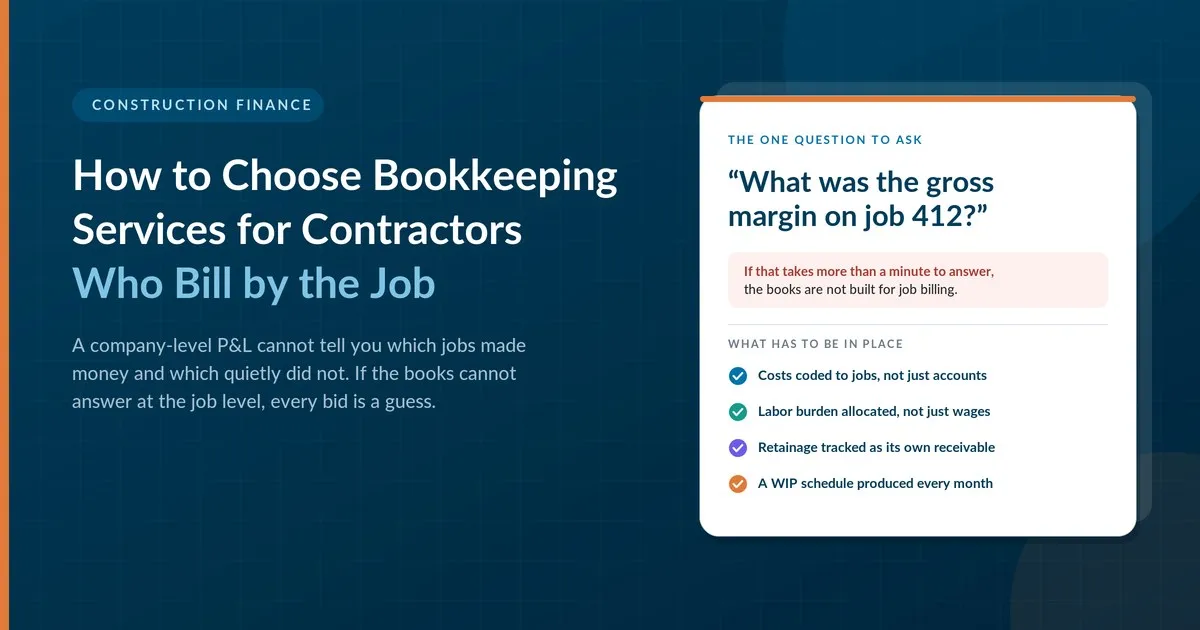
A general bookkeeper often records all of this as one pile of income and one pile of expenses. The result is a profit and loss report that looks fine and tells you nothing. You cannot see which job made money and which one lost it.
A good contractor bookkeeper tracks every dollar by job. That is the core difference.
Six Things a Contractor Bookkeeper Must Handle
Before you compare prices, check that the person or firm handles these six areas. Firms that offer bookkeeping and accounting for contractors should be able to explain each one in plain words.
- Job costing. Every labor hour, material purchase, and subcontractor bill gets tagged to a specific job. You see the true profit on each one.
- Progress billing. The bookkeeper tracks what you billed, what you earned, and what is still left on each contract.
- Retainage. This is the part of each payment a customer holds back until the job is done. It must sit in its own account, not inside regular income.
- Work in progress reporting. This report, often called a WIP schedule, compares the work finished to the amount billed. Lenders and bonding companies ask for it.
- Subcontractor paperwork. Your bookkeeper collects tax forms and insurance certificates before the first payment goes out. In January, they prepare the 1099 forms (the tax form you file for subcontractors).
- Crew classification and payroll. Field workers, office staff, and subs each follow different rules. The bookkeeper should know which is which.
If a candidate cannot explain two or three of these, keep looking.
How Job Costing Shows You Which Work Pays
Job costing is the most valuable thing a contractor bookkeeper does. It turns a pile of receipts into a clear answer: did this job make money?
Here is a simple picture. A flooring contractor quotes a job at $40,000. Materials cost $14,000. Crew labor is $17,000. A subcontractor bill is $4,000. The job profit is $5,000, or 12.5% of the price.
Without job costing, the owner sees only that $40,000 came in. With it, the owner learns the margin was thin. That tells you to raise the next quote or change how the crew schedules work.
For a deeper walkthrough, see this guide to job costing for contractors. The key habit is simple. Every cost gets a job name on the day it is recorded, not at the end of the month.
The Retainage Gap: $50,000 Earned and Still Out of Reach
Retainage surprises many owners, so it deserves its own section.
Suppose a company runs 5 active jobs worth $100,000 each. Each customer holds back 10% until completion. That is 5 jobs × $100,000 × 10% = $50,000.
You earned that $50,000. You paid your crews and suppliers to earn it. But it sits with your customers, not in your bank.
A strong bookkeeper tracks this money as a separate line, called retainage receivable. You see it on your balance sheet, you know when each release is due, and you plan cash around it. A weak one lumps it in with ordinary invoices, and you wonder why the account feels short.
What a Good Monthly Package Looks Like
Ask every candidate to describe their monthly routine. A solid contractor package follows a rhythm like this:
| When | What you should receive |
|---|---|
| Monthly | Bank and credit card reconciliation, job cost report, profit by job, open invoices and retainage list |
| Quarterly | WIP schedule, review of subcontractor files, estimated tax check-in |
| Year-end | 1099 forms for subs, clean books for your tax preparer, final job profit review |
If the offer is only “we categorize transactions,” it is not a contractor package. Treat it as a basic service and price it that way.
Seven Questions to Ask Before You Hire
Use these in your first call. Strong answers are specific. Weak answers stay general.
- How many contractors do you serve today?
- How do you track costs by job in QuickBooks or Xero?
- How do you handle retainage and progress invoices?
- Can you produce a WIP schedule, and how often?
- Who collects subcontractor tax forms and insurance certificates?
- How do you handle crew payroll when workers move between jobs?
- What does month-end look like, and what date do I get my reports?
Ask for a sample report with the customer names removed. A good bookkeeper can show one in minutes.
Check How Workers Are Classified
Worker classification is one area where a mistake can be costly, so ask about it early. The IRS uses a set of tests to decide whether a person is an employee or an independent contractor. You can read them on the IRS page on independent contractor, self-employed, or employee.
A good bookkeeper does not make legal calls for you. They flag the pattern, ask the right questions, and keep records that back up your choice. That habit saves hours when an auditor or insurer asks for proof.
In-House, Freelancer, or Outsourced Firm?
You have three main paths. None is right for every company.
An in-house bookkeeper gives you daily access. It also adds payroll cost, and one person cannot cover vacations or sick days.
A freelancer costs less and can be a good fit for a small crew. The risk is depth. One person may know bookkeeping but not job costing or retainage.
An outsourced firm brings a team, set routines, and backup coverage. You trade daily access for steady reporting and wider skills. For companies running several jobs at once, this path often gives the best mix of cost and coverage.
Choose by asking one thing: who will be able to answer my job questions in month six, not just month one?
A Simple Way to Decide
Work through these steps in order:
- Count your active jobs. Under three, a freelancer may be enough. Three or more, lean toward a firm.
- Check whether you bill in stages or hold retainage. If yes, job costing is not optional.
- Ask for a sample job cost report from each candidate.
- Run a 90-day trial with clear deliverables and report dates.
- Review the first three months. If you still cannot say which job earned the most, switch.
The goal is not perfect books. The goal is a monthly picture clear enough to price the next job with confidence.
Final Thought
Contractors do not need more reports. They need the right ones, on time, tied to real jobs. Choose a bookkeeper who talks about jobs, retainage, and subs before they talk about software. That one choice shapes your pricing, your cash flow, and your tax bill every year.
This article is for general information only and is not tax or legal advice. Consult a qualified professional about your situation.
About the author: Nimesh Soni, CPA, is the founder of Datastub, an outsourced accounting and bookkeeping firm serving U.S. contractors, ecommerce sellers, and growing small businesses.